
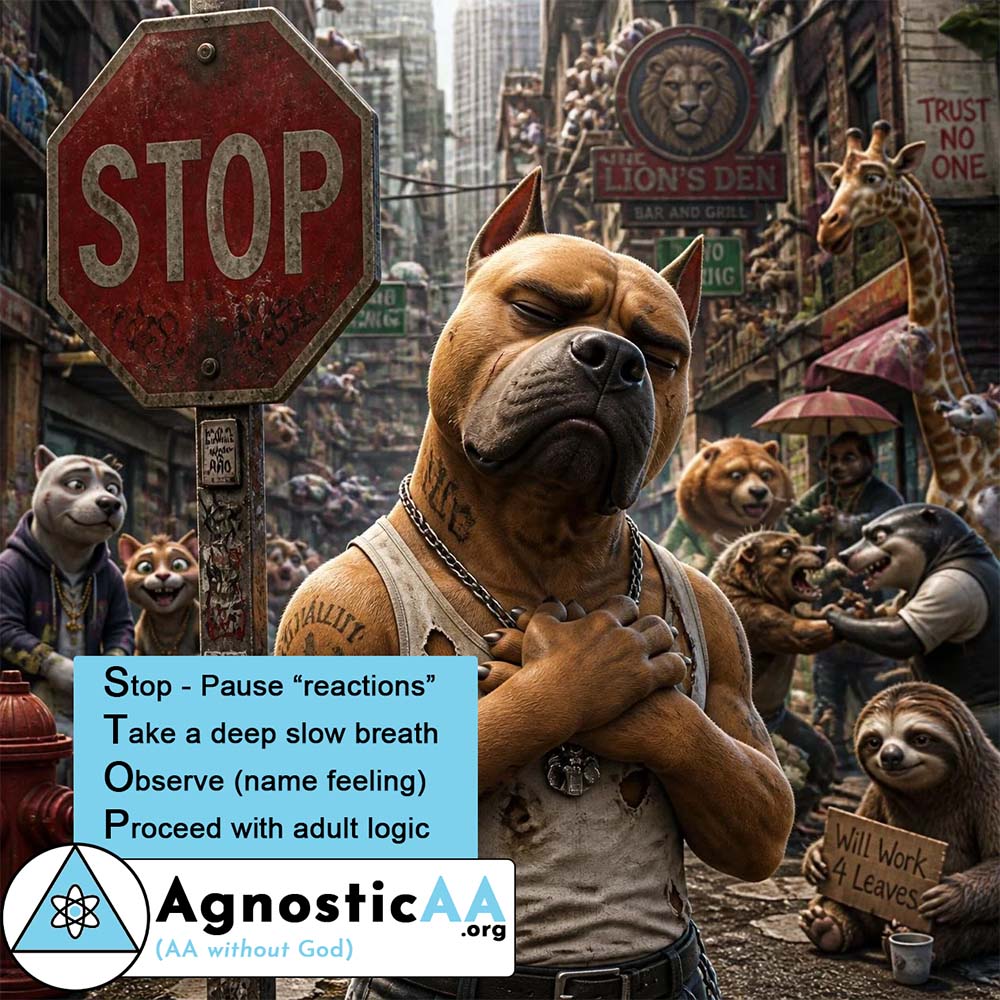
STOP is a handy framework to help cope with those pesky trauma-triggers that often happen in life. Most people operate from a subconscious "learned behavior" in their early childhood. It's baked deeply into their nervous system and they "react" from a place of near animal instinct vs the adult agency of choice. In the case of addicts and alcoholics, reaching for their DOC became the instinct. They found their DOC for one reason or another and it became the priority over all else in their life. Not everyone winds up in a trap house selling themselves for one more hit. However, the basic problem seems to be the same even if a person is a high functioning drunk: Triggers and "trauma" reactions. For example, anger, fear, people pleasing, self doubt, shutting down, isolating, etc. can become the common reaction to even minor difficulties. The STOP framework below may help manage triggers as they continue to arise in sobriety. Sobriety doesn't mean life gets easier. It means we learn an "easier" way to cope with the ups and downs vs picking up again.
S.T.O.P.
Stop: Pause what you are doing or saying immediately.
Proceed: Respond from your adult logic (a drink and/or a drug is NOT the solution to this issue) rather than your childhood defense mechanism. (Run, hide, fight, argue, people please, sex, bully, etc)
Common trauma wounds, triggers and self-management tips.
1. Worthiness Wound
The Trigger: Receiving constructive criticism, feeling overlooked, or making a mistake.
The Sensation: A heavy feeling in the chest, a hot flash of shame, or an urge to over-explain and over-achieve.
Management Strategy:
Somatic Grounding: Place a hand on your heart to physically counter the feeling of shame and lower your cortisol levels.
The Shift: Remind yourself: "My behavior or performance can be corrected, but my inherent value cannot be altered." Separate your productivity from your humanity.
2. Belonging Wound
The Trigger: Walking into a crowded room, being left out of a social plan, or feeling different from a group.
The Sensation: A hollow feeling in the stomach, social anxiety, or a strong urge to isolate yourself before others can reject you.
Management Strategy:
Somatic Grounding: Look around the room and name five things you can see and four things you can physically touch to bring you back to the physical space.
The Shift: Affirm your internal belonging: "I belong in my own skin, and I do not need to morph myself to fit in here." Focus on finding your "right people" rather than pleasing everyone.
3. Prioritization Wound
The Trigger:
A partner or friend text message response taking too long, or a loved one canceling plans for work.
The Sensation: An immediate spike of panic, an urge to spam call/text, or a sudden cold detachment ("fine, I don't care anyway").
Management Strategy:
Somatic Grounding: Practice the 4-7-8 breathing technique (inhale for 4 seconds, hold for 7, exhale slowly for 8) to halt the panic response.
The Shift: Interrogate the story you are telling yourself. Ask: "Is their busy schedule actually a reflection of my importance to them?" Create space between their action and your self-worth
4. Safety Wound
The Trigger: Unexpected changes in routine, loud noises, conflict, or a minor financial surprise.
The Sensation: Hypervigilance, looking for exits, a racing pulse, or feeling frozen and unable to make decisions.
Management Strategy:
Somatic Grounding: Feel your feet flat on the floor. Look around and verbally state out loud: "I am in my house/office. I am an adult. I am safe right now."
The Shift: Separate the current discomfort from actual danger. Remind your nervous system that you have the adult agency, resources, and power to navigate this situation, unlike when you were a child.
5. Trust Wound
The Trigger: A loved one being vague, a coworker making a promise you doubt, or someone being "too nice."
The Sensation: Paranoia, an urge to snoop or cross-examine, or shutting down emotionally to protect yourself.
Management Strategy:
Somatic Grounding: Wrap your arms around yourself in a firm hug or wrap yourself in a heavy blanket to provide deep pressure stimulation to your nervous system.
The Shift: Practice discernment over suspicion. Tell yourself: "I don't need to control their actions; I just need to trust myself to handle whatever outcome occurs."
#sobermeme #traumahealing #traumamanagment #soberinspiration